

From the Garden
November 2025
"Autumn carries more gold in its pocket than all
other seasons."
- Unknown
"In November, the trees are standing all sticks and bones. Without their leaves, how lovely they are, spreading their arms like dancers. They know it is a time to be still." -
Cynthia Rylant
With a full schedule of Garden things to accomplish (so many Dahlias to dig and divide!) plus all the holidays, parties, festivities, etc,. this quote "I cannot endure to waste anything so precious as autumnal sunshine by staying in the house" (Nathaniel Hawthorne) comes to mind. May our November be just as pleasant to work outside as October, and I'll be a happy Gardener.
November always feels a bit like I have all the time in the world to get all the things done that I often find myself getting a bit lackadaisical in the tasks. Oh, I'll get to those weeds tomorrow. Oh, I'll cut that back later. Oh, I'll do that when it's not as nice out and need an inside job. With large garden spaces to fill, however, I don't have the luxury of later or tomorrow, I need to get as many things done now as possible, so that we can hit the ground running come Spring. With getting things done for Spring in mind, it's not too late to plant your Spring bulbs, and I've been found still tucking Tulips into the ground well into December. Not ideal, but we are in a climate we can get away with it. Make haste, however, as your flowering bulbs do need a certain number of chill hours to promote blooms.
Our tulip bulbs arrived later than anticipated, and were not here in time for all of our October Garden Shop openings. If there is anyone who didn't get Tulip bulbs, and feels bereft, please do reach out. I've got Dreamer (double, early Pink Peony type) and Finola (double, late pink) available, and will keep them on hand through November 8 for any of you that want to get some from us. If you, like me, are not always in the mood to brave November in the Garden planting bulbs, I will have them available as cut flowers to grace your vase, in the Spring.
It's hard to believe that I still have to "talk ahead" when it comes to Gardening, but that's the way the compost crumbles, I'm afraid. What do I actually mean by planning ahead? Things like pre-ordering tulips when they are blooming so you get first pick of what you actually want, vs. waiting to see what's left on sale in the planting season. Planting bare root peonies in the Fall vs waiting to plant potted, blooming plants in Spring (there are excellent reasons for this, see Bare-root Planting below) Planning ahead is part of the game, and with so many books, podcasts, experts... take a deep breath, pour a cup of tea, and dig into a beloved book. There is time, and you should plan when you have both the time and motivation. Planning happens when the Garden is growing (take notes!) And when the Garden is asleep (dream away!) it's ok to take your time and make the process enjoyable. My key takeaways this year after watching the Garden grow: plant in layers, so that you have multiple heights to create depth in a garden space; plant in groups, so that your plants make an impact and don't get lost in a mumble jumble; plant what you love, so that you are excited to work in your Garden; plant for each Season, so there is always beauty, joy and motivation in the Garden. And lastly, plant close, so you get a full, lush garden that resists weeds. In my case, that's also planting some of what I missed, that I didn't get to this year, and I'll talk more about those as we move through Winter on into Spring. For now, I'll be tucking in Hollyhock plants, Allium, Fritillary and Tulip bulbs; and planning ahead for our Summer planters in the Wisteria Allée. I know how this works: if l don't plan now, it doesn't happen later.
In this Newsletter
- Bare Root Planting
- Upcoming Garden Thoughts
- Articles of Interest
- January Dance Classes
- Winter Wreath Workshop
- Work Parties in the Garden - 2026
- The Garden Shop
- Recipes for Gathering
- October Review
- Sustainable Home & Garden
- November Garden Tasks
Bare Root Planting
You will likely start to see bare root plants available in the nurseries, and if you are looking to plant fruiting trees & shrubs, or peony roots, this is a great way to go, as bare root plants are more economical, and are available at a time that is the best to get them in the ground going for the growing season ahead. I’ve said it before, and I’ll say it again for the folks in the back that may not have heard me or are brand new here: planting in Fall means healthier, more vigorous plants than those planted Spring-Summer.
All plants used to be shipped, and planted bare root, as the nursery/landscape industry transitioned from the traditional bare-root method to container production in the mid-20th century. Why? Couple reasons, mostly economical. Plastic pot production took off, making durable plastic pots affordable with mass production. Container growing allows the nurseries that grow the plants we buy to produce plants for the nursery industry year-round, so there is no limitation to availability, or when it’s the best time for the plants (bare root is shipped only when plants are dormant, i.e. Fall-Winter). The increased demand for a wider variety of plants has definitely fed into this supply-and-demand chain. Potted Plants have feeder roots that make transplant shock less likely for the end consumer. Also, peat moss. Peat moss bogs have been stripped to be used as soil “amendment” as they help retain moisture, while being light, thus reducing the weight (and cost) of potted plants. Find out here why peat is A Growing Controversy: Should we stop using Peat? And why many growers in the UK are advertising “peat-free” in their growing practice, with signs to boast this all over their booths at the Chelsea Flower Show. While the UK is working to phase out the use of peat, the UK government confirms ban will not be implemented until 2030 and for those wondering why these wide-sweeping practices take so long to put into effect, it is because environmental laws are implemented in phases to allow time for industries, businesses and government agencies to adapt, innovate and to comply with the complexity of new regulations. In the US, it is still difficult to find potted soil mix that doesn’t contain peat, unless you make your own mix, which many smaller-scale growers are moving to doing. However, that requires time, effort and cost, as well as space to store all of the amendments needed to make a quality, well-balanced mix. As you can see, this is a complex problem which will take a bit of effort to solve, and in the meantime, buying bare-root bypasses these issues of excessive plastic pots, and peat moss extraction, so it’s a bit of a win-win for all, really.
Benefits of Bare-Root Planting
💰Significant cost saving
🌳Larger selection of plants (especially fruit trees) available
🚛Often larger, or good-size plants, as the efficiency in harvesting, storage and shipping is an advantage.
🩺Typically healthier plants, that more quickly acclimate to soil conditions, therefore get a vigorous head start on growing.
Roots placed directly into native soil will adapt and grow more quickly than those in potted soil mix placed in the ground. Stronger root system = healthier, stronger plant = better/more 🌸🍎
⛓️Shorter chain of supply. Bare roots get dug from the grower’s field, and shipped to the Nursery, to you. Plants in pots in some cases, will pass through multiple hands/dealers before they ever get to the nursery.
😱No transplant shock!
Upcoming GardenThoughts
I’m setting a goal to include within our calendar multiple events each month that appeal to more than just Flower Lovers, as I think there is nothing more special than introducing Gardens to neophytes. Think Food Festivals, Antiques Fair, Concerts, and more. To that end, I’m looking into producing more opportunities that incorporate our beautiful Garden spaces with vendors, artists, artisans, craftspeople, etc. that are looking to partner in a unique setting to bring more events to our community. Part of this is my effort to truly being a sustainable business, one that continues to take into account our footprint, how we use our resources, while working towards profitability so that we can be a financially stable business entity that can support itself. I think it’s really important to talk about this, as I see non-profit gardens chatter endlessly over lack of funding, lack of resources, and digging deeper to stretch what they have and still be viable to the general public. While we aren’t a non-profit, we still have the same issues of resource (read: advertisting, employees, plants, supplements) needs. Gardens can provide so many opportunities, and offer so much in the way of intangible benefits, but they can only do those things with money. It always feels icky to talk about, but TJ (McGrath) and I spent a great deal of time talking about sustainability, and the financial aspect of it (which it is one of the 3 tenets) and how important it is to both normalize that, as well as take it into account. It can be difficult for us “touchy-feely” types, artists, and Garden-lovers, so it’s even hard for me to talk about it here, but I feel it’s incredibly important to be both transparent and honest, and the reality is that every business needs to be financially viable in order to carry on.
I’d also love to hear what you are looking for, and are interested in. It’s no use for me to plan, if there’s no area of interest in the areas I’m looking at. Would absolutely love your feedback on the following, and I really do see, read, and listen to all ideas and comments I’m given - I love hearing from you!
🏛️What type of classes would you love to see offered?
📢What speakers would you love to see on the schedule?
🌸What floral artists just really speak to you, and would inspire you to spend a day in our Gardens touching flowers with?
🎗️What charitable foundations are of interest to you, that can potentially partner with? (Stay tuned for Charity Garden Tour 2026)
🚶🏻♀️What would inspire you on a Garden Walk?
⛲️How do you want to spend your time in the Garden? No answer here is too big or small - please do share!
🍽️Is it worth looking into hosting our Farm to Table dinners again?
🎟️What have we not done, or aren’t doing, that we should look into?
💗What did you love that we did before, and you can’t wait to do again?
Thank you ever so much for your time, energy, and thoughtfulness in responding to my questions. I really want to share this Garden with you, but need to be able to manage it in a way that ensures it carries on in perpetuity. I so appreciate you understanding all of the facets that go into planning and hosting events, and I in turn, appreciate you sharing in this dialogue with me.
Articles of Interest
It’s funny how the universe works, I had set the itinerary for this newsletter end of October, and this article on why you should embrace bare-root planting popped up. I guess it’s just that time of year, but bare-root is the way to go as far as planting trees, hedging, fruit, or canes.
Always good to get advice from the experts, and here they share 10 Tips for Planning a Spring Bulb Garden which all I can say is, you’ll be ever so glad you planted bulbs come Spring. Whether it be in ground, in large containers dressing up a front porch or back patio, or even in smaller planters, just do it.
If you’re looking for ideas to freshen up your window boxes, check out how to plant beautiful window boxes for every season. I just love a home dressed with window boxes, and it’s definitely something you see in abundance in the Southern part of the United States, as well as Europe. Maybe this is the reason or excuse you need to add them? My friend Camille has them hanging over the railing of her balcony, so if you’re hesitant to install them on your home, consider a point in the Garden where you can hang them, to add more plant interest at hand or eye height. Amazon has loads of options that are affordable, but if you’re looking for something with a bit more panache or durability, shop around. For a splurge, check out Detroit Garden Works.
Raise your hand if you’re one of my veg-forward gardeners? I will forever stand firmly planted with one foot in edible gardening, and one foot in flower land. For inspiration, and eye-candy into some beautiful gardens to visit over the internet, this interview with Kathy Slack gives you permission to start out easy if you’re new, and to dream big if you’re old hat to the veg plot. My personal recipe for success? Grow a tried-and-true, something new and different, and something you’re really excited to try, even if you’ve no idea it will work. On my list? Growing capers from seed!
Not an article, but rather a book to share, one I couldn’t wait to crack open and dig into Garden to the Max: Joyful, Visionary, Maximalist Design by Teresa Woodard, photography by Bob Stelko. The photography is stunning, the Gardens are inspiring, and it will have you wanting to start wild plant collections - a bit of winter dreamscaping, perhaps?
Since November is devoted to Dahlias in our neck of the woods, Digging, Dividing and Storing, here’s a video we filmed a few years back, as we start to develop more content devoted to all things Garden-related. Stay tuned for upcoming videos showcasing Garden projects, and even making things in the Kitchen with what we grow. This particular video is me dividing some Dahlia clumps from tubers planted that year. I can tell, based on the size alone, and this is my sweet spot for dividing. It’s so much easier to see what you are doing, see the eyes, and have a manageable task. Older tuber clumps, that have been in the ground 2 years or more, become a whole different ballgame to deal with.
Watching Practical Magic had me yet again dreaming of the stunning interior world created by Roman and Williams, and every time I’m in NYC, I step foot into the beautiful world they curate. If you’d like to read more about the set design by these architects and designers, check out Roman and Williams: Things We Made by Stephen Alesch. The completely fabricated house that was made for a movie set and then demolished, is featured in the book, and was so famous, Barbra Streisand called them directly to buy it after seeing the movie. My particular favorite was the kitchen and plant room interiors with all the dried botanicals, herbs, and concoctions - an Apothecary right in the home. A girl can dream, right? Roman and Williams website
If you’re looking for some gift ideas for the Garden-lover in your life, consider joining a local organization, or a subscription to a beautiful magazine your person can enjoy year-round. Here are some personal favorites (we get zero kickbacks, this is not a paid ad, just sharing what we love) and bonus, this saves you a last-minute trip to the shops when they are absolutely insane and parking is a bear:
Flower Magazine: Give as a Gift
The English Garden Subscription
Of course, I’d be remiss if I didn’t include our own Garden Shop in the mix for gift ideas; as I think we have some garden & home items that make terrific gifts, whether it’s something meaningful as a host gift for the holiday party season, a sweet stocking stuffer, or something extra special to tell someone how much they mean. One of our sweet guests bought our vintage milk bottle vases to tie up with dahlia tubers from her garden. I just love this idea: a packet of seeds, some bulbs/tubers, or a flowering plant along with a special vase gives such a unique touch to a hard good standing alone.
As Beth Chatto wrote "“Too many star performers lumped together can become quarrelsome; neutral areas between them keep the peace. Sedums make very good peacemakers and are so dependable on hungry soils, providing interest for almost every month of the year; few herbaceous plants can do that.” And we agree when it comes to Sedum, aka Hylotelephium. Sedums start to flower in summer, their colour getting more and more intense, but they always play well with others, and hold a special (and robust) place in our Gardens.
Do you love Brassicas as much as I do? There are so many edibles in this plant family, and they absolutely thrive in the cooler months, so Spring and Fall are their sweet spot, and many will soar through our winters as well, if you can handle the hardscrabble months when not much else survives, and the inevitable frozen fingers from cutting back kale leaves in the dead of winter. In common brassicas pests and diseases the 3 major pests are solutions are discussed.
We all love Clematis around here, and in Autumn-flowering Clematis you’ll learn exactly what varietals Richard Hodson of Hawthornes Nursery (in England, sadly) recommends for extending a longer period of interest in our Gardens. Autumn is already so beautiful, but it seems we can make it even better. While we can’t source from his nursery, we can certainly get plant names.
I’m so happy I found a source for the now defunct Annie’s Annuals & Perennials. While former employees took over the closed retail space and nursery, the online shopping/shipping portion found a new home at Grow Organic and I’m happy to see some of my favorites for the cottage garden become available again. You’re welcome. 😉
For those Garden-planning ahead, Cues to Care: How to design an ecological garden that still looks cultivated, this series discusses how to be more sustainable in landscapes at home. Not often talked about is the barrier to ecological Gardens (read: native, sustainable or whatever buzzword/catchphrase of the day you want to use) bump up against Aesthetics, and barriers limit both accessibility and acceptance. Whether it’s dealing with an aggressive HOA, a demanding neighbor, or even a partner that has specific ideas about how a yard/garden/landscape should look, this article tackles sustainability in Gardens head on, and gives specific, achievable ways to achieve cues to care that will have everyone happy.
January Dance Classes
Regretfully, I’ve cancelled the November dance classes, as I wasn’t getting any interest. I’m a bit sad, but I understand that it’s a busy month and time of the year, so let’s try again in January, shall we?
I did have a lovely guest ask me if she and a friend can take the classes, as their husbands didn’t want to sign up. The answer is yes, but I’d highly encourage you to motivate your partners to take lessons with you. It’s such a great activity to do together, and how many of us have things we actively DO with our partners? Not to mention, learning together means that you have a skill that you can both practice, and even better, do together, which is the whole idea. If you don’t have a partner, you are more than welcome to sign up, but we cannot guarantee the couples will want to change partners, and Steve can only dance with one gal at a time.
Dancing is such a great physical activity, I think it’s important in our dark, cold winter months to stay as active as possible. For our bodies, for our minds, for our attitudes. So please, indulge me, as I both love teaching dance, and I love moving, and I would love to share both of those things with you in our newly restored Historic Barn loft, where we have a terrific sound system, brand new restrooms, and a beautiful dance floor - the perfect ingredients to have some winter fun together!
You’ll see an option for Single or Couple tickets: this registration should only be done once per person or couple, as it covers the 4 group classes offered, all lumped together. In January, we will be learning and dancing the Waltz and Rumba, and I will prove to you how great having these 2 dances in your back pocket, and feet, will be, whether you’re at a wedding, cruise, concert, or just slow dancing in your backyard under the stars.
Winter Wreath Workshop
Our Winter Wreath Workshop on November 22nd filled up rather quickly; so I’ve had several asks if I can do another, and if you’re one that would like to put together a group, I’m happy to do private Wreath classes for small groups. Minimum of 5, and 10-12 max is best for the perfect cozy setting to craft together, and we can discuss all the details. Please reach out to me directly at info@laughinggoatfarm.com to get information, and to arrange. Time and dates will be mutually agreed upon, and take into account the time needed to prepare for the class.
Workshop Description:
Learn how to build a wreath with all natural materials, using seasonal, locally-sourced greenery and dried goods, for a long-lasting Winter Wreath.
Ditch the mass-produced, copy-cat wreaths available at all the big box stores, and learn how to make your own wreath using stems, branches, and a simple frame. Once you have this skill, the possibilities are endless, as you can apply these techniques to dried florals, flowering branches, and even Spring wreaths using pussy-willow!
A skill you can own forever is worth its weight in gold, and you will leave feeling confident to do this on your own, at any time. Not only that, but you will have a beautiful wreath made by your own hands, to hang at your home, or gift to a cherished friend, for the holiday season. We source greens from local growers and our own Gardens, so you won't have any product sprayed with nasty chemicals.
Work Parties in the Garden -2026
Continue to stay tuned as I fine-tune and arrange the details for Garden Work Parties. They will be happening again, only with a twist, and may include flowers!
The Garden Shop
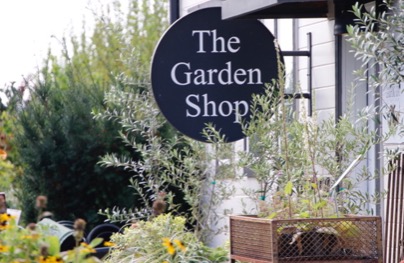
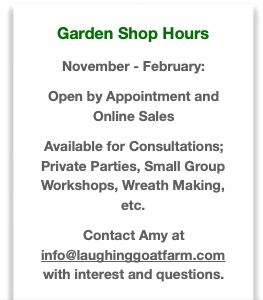
Please do consider our Garden Shop for your holiday shopping needs, as you seek out the perfect gifts for the Gardener, Chef, Host, or anyone in your life wanting substance meets style over just random stuff. I’m over the moon to open our Shop for you to peruse our offerings, or check them out in our Laughing Goat Online Shop first. We do have some items not listed, as they are exclusive to our Guests who visit us in person. Do use me as a resource, as I both know our inventory, and have so many gifting ideas, I can’t wait to help and share. With any budget in mind, I can help you gather everything you need to delight whoever you are gifting. I love a puzzle, and this neatly fills that spot.
Recipes for Gathering
When it comes to holiday meals, are you Team Traditional or Team Whatever Floats your Boat? Holidays are a great reason to gather, and typically that comes with buffets, sideboards, counters, and tables heaving with dishes that everyone craves. And the leftovers! Isn’t that the best part?
As for me, and mine, we tend to lean a bit more simple, and while still refined, want our meals to focus on the Season, and on the people around the table. For smaller gatherings, I will do a roast chicken instead of a turkey, as it is both an easier task and less of a feat to keep the bird from drying out in the cooking process. Smaller, more intimate gatherings seem to be best for truly connecting with the each person around the table in a meaningful way, and the mess is less, which just feels more manageable. We do these crafted dinners with our friends and family in batches, as respecting food preferences and dietary needs for larger groups can be fraught with challenges and stress.
So, I’m leaning more into side dishes that utilize the best of what’s in season, amp up the table decor, and provide both nutrition and flavor packed into a pretty dish. With that in mind, here are some sides I’ve been dying to try, and a few favorites, that can enter the rotation for your Fall dinners, or become a timeless treasure for the Holidays. However you do your celebrations, make the meal special in your own way. That’s what the holidays are about, is the gift of sharing your time, talent and love, and what better way to do that than through a shared meal, made with love?
I absolutely love Cabbage, in pretty much any form, and have dog-eared the cabbage section in Six Seasons by Josh McFadden (the cabbage soup with Farro recipe is mind-blowing good and so simple), so this Red Cabbage with Walnuts and Feta recipe intrigues me. Melissa Clark is pretty much a home-run hitter with her recipes (her book Dinner in French is another favorite) and the vibrant colors of this dish deserve a spot on any table.
Stuffing often is widely discussed as the quintessential Thanksgiving side, going hand in hand with turkey, but for those of us watching our carbs (I know, boring) or wanting an alternative that has a bit more texture, I give you Caramelized Onion, Cranberry, and Rosemary Tahchin, a crusty, crispy Persian rice dish that promises bold flavors, and a bit more crunch that stuffing can provide. Even if you save it for another occasion (I could build a whole meal out of this, a green salad, and a protein) do try it.
This is one of the dishes that I keep going back to, and while I haven’t made it every year, it’s worth revisiting. Roasted Brussels Sprouts with Asian Vinaigrette just packs a flavor punch, full of Umami, bristling with enough acid to counter-balance all of the rich and creamy, it’s honestly crave-worthy. I have to make this one for a crowd, as it’s a difficult dish to scale for a smaller party, but the blessing of this dish, it’s equally delicious fresh and hot out of the oven, or at room temp. Not every side dish can boast this party trick, so worth keeping in your back pocket, and the leftovers are great too (just leave the puffed rice off so it doesn’t get soggy).
Potatoes are obviously always a crowd favorite, and everyone seems to have a favorite, or “best” way to make them. Usually, they seem to be mashed, and while I’m not going to Yuck your Yum, I am going to push back a little on putting foods with texture (see a theme here with all of these yet?) on the table with crispy roasted potatoes. You know what I’m talking about. Perfectly golden-brown, crunchy on the outside, hot, steaming and soft on the inside. It’s a hat trick to pull this one off, but I absolutely promise you there won’t be a single spud left if you put this one out. I make these every year, on request, and I never seem to make enough, even though I keep doubling, and even tripling the recipe. Seem obscene? They’re THAT good. Side note: the Avocado Aioli is delicious, but the potatoes are good enough to stand alone, so maybe on the side for those that want it, and you can try it both ways. Crispy Potatoes with Garlic Lemon Avocado Aioli. I will choose these over mashed potatoes any and all the days of the week.
I’m that girl: the one who always brings a kale salad to the party. Why? Kale shines in the Fall, is packed with nutrition, and when prepared properly (I honestly still want to do a class on this alone) is absolutely delicious, and holds well to being made ahead, transported, and even being a leftover. What other salad green promises all of that, and maybe a side of controversy? While I have my 2 tried-and-true favorites (hint: one is in Six Seasons) I do think you should have a go at this, if you’re still looking for a kale salad you love. Lemon-Garlic Kale Salad has the necessary ingredients to “break” the fibrous quality of kale leaves down to make them easier to chew. Just make sure you remove the ribs, for the love.
I’m not a pie girl. I’ve tried to be, as I enjoy making them, and I just love how a well-made pie looks on the counter. My Grandmother was a stellar baker and made beautiful pies, so it’s in my DNA. They just aren’t my jam to eat. Having a pie-alternative is high on my list, and while there are many options, I’m excited to try these Cranberry-Lemon Bars, and if everyone else still wants pie, well, that’s just more for me.
Let me know if you try any of these, and what you think…I love to talk food, recipes, cookbooks, food…
October Review
October was a busy month for us, with an activity to gather planned for every weekend. I so enjoyed getting to hang, and chat, with our Garden friends, and I know I’m going to miss seeing you all over the next few months, but please know I’m wishing you the merriest and brightest of holiday seasons.
October 4: Garden Work Party
October 11: Final Garden Walk
October 18: Tulip Planting Party
October 25: Book Swap & Dahlia Dividing Workshop
We ended October dealing with the after-effects of a windstorm, which saw a broken Cottonwood that fell on our property, barely missing our border fencing, and narrowly missing some of our back border plants. A nursery run to Kent East Hill Nursery to grab our special-order plant delivery, plus a few more that caught our eye, and planted 14 trees and shrubs in our Pond area. Next on the list for the Pond is placing the remaining French Heirloom lilac shrubs from the Cutting Garden, then underplanting with Perennials, placing a walking path for Guests, and building a bridge over the stream. On Halloween, I slung 28 Sedum Dark Magic and 100 Dreamer Tulip Bulbs into the Wedding Garden whilst getting rained on, but carried on until the job was done, like a boss. In between jobs, I darted into the Greenhouse to check on heirloom Radicchio seedlings, bumping up those ready, and repotting all of my Aeoniums and Succulents for a winter in the Greenhouse. I’m thinking ahead to where and how I will display my collection in the Garden. All this while a crew worked on facing the back side of the Stone Arch with Texas limestone, to finish that up.
I also dug deep into Dahlia Digging and Dividing, plus creating an inventory for planting plans, and 2026 tuber sale in the Garden Shop, as well as started full steam ahead with cutting back the Peony Field. There is much to be grateful for this season: so much beauty in the Fall Garden! Beautiful sunrises and sunsets! The Fall colors are magnificent! The bird migration was epic! There is still much to be done: the English Garden planting project! The Orchard! The Cutting Garden! The Pond planting! Revitalizing and updating our Potager Garden!
Sustainable Home & Garden
We can all do little things that are better for the planet, and make our lives better to boot.
Let’s talk about black bulb crates, and all their uses. One thing for me, with sustainability, is having things that are sturdy, useful and have a purpose, so that I’m not just taking up space saving things with the hope or potential of us (ahem, hoarding) but rather, keeping things around that I love, and that I actually use. That last bit is rather important to me.
Black bulb crates are a perennial favorite. They are what bulbs, and other plants such as bare peony roots, are shipped in from the wholesaler to the end user: us. Most nurseries, and gardens, end up with stockpiles of bulb crates on hand, and they get put to great use, as they are just so darn handy. We are lucky, in that typically, when I bring in bulk plants like bulbs, peony roots, etc. I get them in bulb crates, which I get to keep after the plants have gone into the ground.
I saw extras for sale at a nursery run we were on this past Summer, and since I didn’t bring enough of my own crates, I ended up buying an extra to tuck plants into for the drive home. Simply put: they are outstanding plant holders for your nursery runs. If we end up with a surplus, I’ll put them out in the Garden Shop, we just haven’t quite reached that stage of bounty yet, and what I have is almost always in use in some way or another.
Ways I use my black Bulb Crates:
🪴Organizing plants in pots, for planting. Each crate holds many plants, and with sturdy keyhole handles, they’re perfect for lugging around plants when you have more than a handful to carry.
🌷Organizing your bulbs, when it’s time to plant in the Fall. If you’ve got more than one variety, simply dump each type, or each collection, into a crate, and carry that out for planting. Way easier than dealing with digging bulbs out of those obnoxious mesh bags or tiny cardboard boxes.
🍽️Storing catering supplies, excess dishes, tabletop items, etc. We use these crates for all of this and more, on industrial shelves, and they are so easy to grab and slide out to access what we need, plus I can see exactly what’s in them. No need to buy plastic storage bins (unless you need a lid for dust)
🌳Nursery runs are made so much easier with a bulb crate. With higher sides than those meager cardboard boxes (which are typically single use) they are better at keeping plants upright for the drive home, and they are useful over and over again. Simply hose them off and air dry when they get dirty.
🛒Keep a bulb crate in the back of your car always, and you can even use them to put grocery bags. I think a bulb crate will hold either 2 or 3 fully stuffed standard grocery bags, and again, keep them upright for the drive home.
🪚Use one to keep all of your Garden tools together, so all you have to do is grab the crate, and head out into the Garden to get to work. You can keep a kneel pad, gloves, bucket(s) for harvest, hori hori knife, and anything else you need all organized, and visible, easy to grab, with one crate.
🧵If you are going to a crafting event, Garden club activity, potluck, bulb crates are multi-purpose and can do it all.
November Garden Tasks
Tasks
- Insulate vulnerable outside containers from Frost, Use hessian or bubble wrap, and tie in place with garden twine.
- Prevent containers from becoming waterlogged and/or clogged with leaf debris by lifting off the ground for winter with bricks or pot feet.
- Encourage hungry birds into the Garden by investing in bird baths and bird feeders. Bird feeders must be managed by deep cleaning weekly to avoid wild birds spreading disease. Best practice is to plant things that will provide winter food to birds.
- Protect roses from wind-rock by pruning them by one-third to half their height. This stops swaying in strong winds that causes roots to rock and lift out of the soil, and also helps prevent branches crossing and causing damage to bark from rubbing.
- Remove any fallen leaves from rose bushes that suffered from black spot or rust over the summer, and dispose of them in the waste bin, to help reduce the risk of infection over the next growing season.
- Remove any fallen leaves from Lilacs that suffered from blight, to avoid fungal spores overwintering in the soil, and reinfecting the plant in Spring.
- Continue to lift dahlia tubers, gladiolus corms and begonias tubers that you want to save, to dry-store over the winter months. Remove any spent foliage before storing.
- Cut back yellow foliage of herbaceous perennial plants, and lift & divide any overcrowded clumps to maintain vigor. Spread new plants around to fill in bare space in the Garden.
- Continue Sowing your Cool Flowers & Vegetables Fall Cool Flowers
- Plant early Spring Bulbs, including ones tucked into Containers, beds, borders and meadows.
- Keep weeding.
- Lift parsnips after the first frost, when their flavor is sweetest.
- Prepare a perennial vegetable bed to be planted with rhubarb, and a separate one for Asparagus.
- Plant all garlic and shallots.
- Spread compost, well-rotted manure, or leaf mulch over all of your vegetable beds to row down over winter, and protect your soil.
- Stake any top-heavy brassicas and leafy green plants. Making a cone of soil up around the base of their stems to help prevent wind-rock damage to roots.
- Check over storage of onions and garlic to remove any that have rotted, before they spoil the bunch.
- Divide mature clumps of rhubarb once dormant, and replant.
- Plant out currant plants as bare roots this month, while they are dormant.
- Plant bare root raspberry plants now.
- Tidy up strawberry plants, removing any dead leaves and all runners.
- Prune apple and pear trees now through February.
- Do not prune plum trees to avoid silver-leaf fungus.
- Plant bare root edible hedging while dormant.
- Check any fruits, including winter squash and pumpkins, in storage and remove any that show signs of disease and/or rotting.
- Secure any newly planted trees and large plants before strong winds and heavy rains can cause damage.
- Restock any Greenhouse and seed-starting supplies needed for growing your 2026 Garden. We look at our seed trays, seed-starting mix (available in our Garden Shop), pots, Sure Start, and potting mix to make sure we are well-stocked.
- Be caution when watering plants in the Greenhouse as winter approaches: little and often is key!
- Sweep up debris and leaves from paths to prevent fungal spores and overwintering home for slugs and snails. Spread around the perimeter or put in a leaf mulch bin.
- Lift and relocate any plants that have outgrown their space, as they are dormant now.
- Create bins for composting fallen leaves and dead plant material.
- Take stock of the Garden, and make a few notes and/or sketches for next Spring. Reflect on what grew well, what didn’t, and what changes you’d like to make. This list can be useful when ordering seeds and plants.
- Take photos or make maps of where herbaceous plants are located before they die back so you don’t step on crowns and new growth, or damage roots during a winter dig. You can make them with stakes, flags, or I often use tomato cages, which if secured, are a great secondary use for them.
- Place online orders for fruit trees, shrubs, and perennial plants. Any of these can be planted Fall - Spring